Saturday, November 19, 2011

The Subtly of Cults...and the Watcher Tower Magazine


Today, as my wife was taking my daughter to art class, some Jehovah’s Witnesses came to the door to talk to me and my son who were staying home.  I do remember the same fella that came because I had taken his literature and said thank you – that was all, although I had to constrain myself not to tell him about the evils of following a cult like the Jehovah’s Witness.  This time I did the same thing – took the literature said thank you and they left.  I opened the Watchtower, their monthly publication, and began to flip through the articles.  The one at the very end caught my attention and my frustration.  It was titled, “When Was Ancient Jerusalem Destroyed?”  The Jehovah’s Witnesses say that the destruction of Jerusalem occurred in 607 BC, rather than the traditional (and correct) date of 586 BC.  The article continued to say that this was the first of two articles that discusses the date surrounding the destruction of Jerusalem with thoroughly researched and Bible-based answers.  As I read that tag line I thought to myself, “oh really now....hmm lets see what you have to say.”  So, since I wrote a full-length doctoral dissertation on the book of Daniel and have spent at least 4 years studying these issues that they discuss in the article, I thought I’d sink my teeth into their writings. 

Destruction of Jerusalem by David Roberts (1850)
I will be brief as possible; I don’t want to get bogged down into too many technical details.  Here is the belief of the Jehovah’s Witness: the destruction of Jerusalem occurred in 607 BC.  My belief, along with at least 20 other published scholars and writers, countless Bible teachers abroad, and classical historians, is that the destruction of Jerusalem took place in 586 BC.  What I can seem to gather about their belief is that since the period of the 70 years of captivity of Israel ended in 537 BC, then 70 years earlier would be 607 BC.  Therefore, the destruction of Jerusalem, they say, took place in 607 BC.  They quote from Jeremiah 29:1,2,11 which says that “the whole land of Israel will become a desolate wasteland, and these nations will serve the king of Babylon for 70 years.”  They further support their claim saying that Daniel 9:1-2 says essentially the same thing: at the end of the 70 years of captivity Israel would be restored and that would mean 70 years earlier Jerusalem was destroyed.  Now, here is line that made me frustrated, “But if the evidence from the inspired Scriptures clearly point to 607 BC for Jerusalem’s destruction, why do many authorities hold to the date 587 BC.”  WOW!  They are making this important claim based on two lines of evidence, maybe three....all of which ARE NOT “thoroughly research and not Biblically based.”  

Before I show you the error of their ways, let me first explain some chronology about the destruction of Jerusalem and Babylon’s role in bringing this.  Bible and historical records show three distinct times when Nebuchadnezzar came to the land of Israel to deport captives and lay seize to the city.  The first deportation took place in 605 BC (Daniel 1:1-2).  This was when Daniel and other royal captives were taken to Babylon as prophesied by Isaiah, along with some of the temple treasures.  Interestingly, nothing is mentioned in the Watchtower article about Daniel chapter 1.  The second deportation took place around 597 BC (2 Kings 24:14-16), when Jehoiachin, Israel’s king and Ezekiel the prophet, along with many others were taken into exile, and the rest of the temple treasures too.  Then, Nebuchadnezzar made Zedekiah the king of Israel.  The third deportation took place in 586 BC (2 Kings 25:8-10), which was in the 19th year of Nebuchadnezzar.  The reason for Nebuchadnezzar coming this time was the rebellion of Zedekiah (2 Kings 24:20-25:1).  This was the time when Jerusalem and the temple was completely destroyed

Now lets talk about all the evidence, not the selective evidence that the magazine gives.  The magazine is right in saying that the captivity will be 70 literal years, but the destruction of Jerusalem did not commence this period of time, there is just no Scripture evidence for this.  Jeremiah does say though that the land and its inhabitance will be laid waste for 70 years, something he prophesied during the very first year of King Nebuchadnezzar’s reign (Jer. 25:1).  It seems that much of their evidence relies on one Scripture text: Daniel 9:1-2.  It’s never a good thing to rely on one text for such an important event.  Daniel gives us some more insight into the matters at hand.  He interprets Jeremiah’s 70 years prophecy to be literally, which caused him to intercede for his land to be restored.  Daniel’s prayer is taking place at the end of the 70 years; hence that is why he is praying for restoration.  Daniel notes the “desolations of Jerusalem,” something that he had witnessed or was reported to him while he was in Babylon.  But the word “desolation” does not mean destruction.  Comparing also Nehemiah 2:17, we see that the Bible calls Jerusalem devastated even after the Jews had returned to it.  The term devastated place or devastations does not then have to be applied just to the time after Jerusalem’s destruction, but can rightly apply to the entire period.  Jerusalem, as I noted earlier, was seized on three different occasions: 605, 597, and 586.  The last seize of Jerusalem and the temple completely annihilated everything.  The prophet Jeremiah writes the Book of Lamentation about this event, he laments the destruction of Jerusalem. Zechariah proves to be helpful too, but time does not permit that study or the Septuagint evidence.         

Now, there is documented archaeological evidence since at least 1975 that shows that Jerusalem was completely destroyed in 587/586 BC.  Even Wikipedia attest to a 586 BC date, fancy that!  But where is that listed in their article? I do agree that chronology can be frustrating and confusing at time, but when you blatantly say and publish that the evidence of inspired Scripture clearly points to a 607 BC date for Jerusalem’s destruction you had better have an air-tight case with indisputable evidence.  Obviously, they do not.  I think the key idea that bothers me the most is that they do not consult all of Scripture, but are selective.  As I said before, there was no mention of cuneiform documents, no mention of Zechariah’s prophecies, no mention of Nehemiah’s words, no mention of Daniel 1, no mention of the Septuagint.  How can a publication state that their evidence is biblically based and thoroughly researched when they obviously missed many things?  I don’t know.  Maybe next months magazine will have their answers.  Be careful of the subtle deception that any cult brings, there is a lot of truth to the article that they wrote, but a careful and biblical eye will find the inconsistencies and see their errors.  The proven way to reveal that something is false is to handle the real thing – the Word of God.  

Friday, November 11, 2011

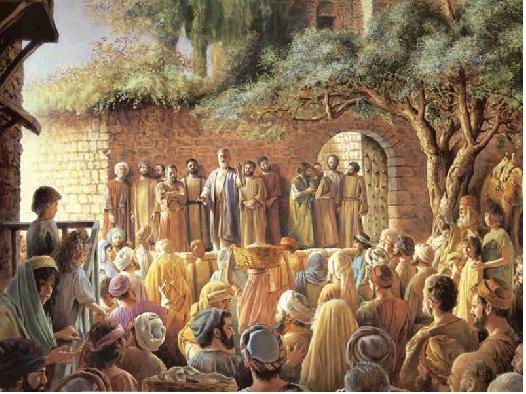
Peter's First Sermon


Acts 2:12-39

Josephus, the Jewish historian, informs us that the normal population of Jerusalem was roughly 150,000.  However, at this particular time in Acts 2 with the celebratory Feasts of Weeks and the Passover day to follow, there were roughly 1 million people in Jerusalem.  It is at this time that the Church begins its work in the world.  As the noise of something miraculous begins to filter into the streets and countryside, people gather into the temple to witness the events for themselves.  The text of Acts 2:12 says that some people were perplexed, while other were amazed, and some had already passed judgment on the event.  Realizing that this miracle of speaking in tongues had caused such commotion, Peter like Jesus, stands up and addresses the captive crowd.  If we read the Gospel accounts, we find that Jesus did not waste a miraculous event  – it always had a purpose of explaining the Gospel message to the person or the crowd.

Essentially, Acts 2 provides us with Peter’s first sermon.  His theme: Jesus is the Messiah; a theme that would be part of most other sermons and speeches in the book of Acts.  Peter refutes the charges that the Apostles were drunk and then he continues to demonstrate the purpose of this miraculous event.  Peter shows that Jesus is the Messiah with five proofs.

The first proof is Jesus miracles during his earthly ministry (v.22).  God authenticated Jesus through miracles and signs.  He turned water into wine, calmed the winds and waves, cast out demons, healed the sick and lame, raised the dead, and more.  The second proof is an Old Testament prediction of the resurrection (vs. 23-31).  Peter informs us that the perfect life of the Christ would allow for such a resurrection to take place.  Then, Peter further explains that the reference to the “Holy One” in the Psalms passages is not a reference to David but to the Messiah thereby predicting the resurrection of the Messiah.  A third proof is found in vs. 32 where the Apostles say that they were eyewitnesses to His resurrection.   A fourth proof is Peter’s appeal (v.33) to the supernatural events of Pentecost that were sent by Christ.  In this verse, Peter says that that “He (Christ) poured out what you now see and hear.”  The fifth and last proof that Peter gives for his claim of Jesus as the Messiah is the ascension of Christ.  Peter says that David did not ascend to heaven, rather Jesus did (cf. Acts 1:9-11).  Peter closes out this five-point sermon with the simple conclusion that Jesus is the Christ (or Messiah), the very one that you (the crowd) has crucified.

Because of Peter’s persuasive, Spirit-empowered message, many people were convicted and needed to be instructed on what they needed to do to make things right.  Peter tells them to repent of their actions, meaning a change of mind concerning who the Messiah was.  Up to this point in time, the Jewish mind thought Jesus was some kind of false Messiah and the True One had not come yet.  However, Peter convinces them otherwise, and so they change their thinking (now having all the right information) putting their faith and trust in the real Messiah.  Next, they are ready to publicly show others this new life they have received through water baptism.  Now, the Holy Spirit that came on Pentecost, dwells in the hearts of each believer when they believe in the real Messiah – Jesus Christ.  But wait!  Don’t miss verse 39 that says that this promise of salvation is offered to all people.  And so the witness of the Church begins at Pentecost and is still penetrating the hearts of people today.  

Monday, October 31, 2011

Celebrating the Reformation!


The day was October 31st and the year was 1517.  Previously, a German monk named Martin Luther had been struggling with the Scriptures that he had been reading.  Why was he struggling?  Well, the Catholic Church, which he served, believed one thing about this doctrine of salvation, yet the Scripture taught a different story: which story was he to believe?  The Catholic Church taught that man was responsible to the pope and church leaders, not to God alone.  They further taught that man needed to do good works to gain acceptance into heaven, or earn their righteousness.  But the Scriptures that Luther read and the doctrine that his church taught did not agree. 

As Luther struggled with this, a new fundraiser that the church instituted began to frustrate him further.  Various methods of raising money for the building of St. Peter’s Cathedral in Rome were being employed, but the one that irritated Luther the most was the selling of indulgences.  The Catholic Church had authorized Johann Tetzel to sell indulgences as means of raising money for the building of St. Peter’s Cathedral.  The term indulgence and what it means has a long history of use and abuse in the Catholic Church (something that could be a discussed in length on another occasion).  However, for our purposes, we are looking at indulgences from the eyes of Luther and the aggressive marketing tactics of Tetzel.  Tetzel taught the people a common jingle, “as soon as the coin in the coffer rings, the soul from Purgatory springs.”  Luther interpreted this phrase from Tetzel to mean that the Church is selling indulgences that would free loved-ones who were in purgatory and give themselves license to sin.  In essence, Luther thought that the church was selling certificates of salvation!  Many people still assumed that that Church had rule and authority over them and so they were purchasing these indulgences daily.  This outraged Luther and he spoke out against this practice saying that it was not in line with the Word of God.  The most famous display of his outrage was when he posted the 95 Theses on the Church doors in Wittenberg, Germany on October 31, 1517.  A “theses” means a grievance.  So, Luther posted 95 complaints he had with the Catholic Church and their teaching (now don’t you readers do this to your church doors, besides these grievances were doctrinal not because these disliked the color of the carpet or the music).  In fact, Theses 28, specifically objected to the teaching of Johann Tetzel and his infamous jingle.        
Printed indulgence certificate signed by Johannes Tietzel (Tetzel). 
The German text reads, "In the authority of all the saints, and in 
compassion towards you, I absolve you from all sins and misdeeds, 
and remit all punishment for ten days." 


Surely, Luther thought to himself, if I bring these discrepancies to the knowledge of the church leadership they will want to discuss this wrong doctrine that they were teaching and promoting.  The nailing of a list of grievances on the church doors was a common practiced that often pushed for further study and debate on the issues posted; he wanted to initiate scholarly debate.  Luther chose this date for posting his theses because the coming holyday would bring many of the community to services, ensuring that his statements would receive wide exposure.  The reactions that he received were vastly different than what he had anticipated.  First, the Catholic Church and its leaders did not want to debate, they did not want to change anything because they did not think that they were wrong.  Second, the people of Wittenberg and many others had read Luther’s writings and were in agreement with them.  Luther’s writings were spreading like wildfire and the church wanted to squelch them as quickly as possible.  They brought Luther before a religious court and gave him opportunity to recant his teachings and his writings.  He chose to respond in these words: “Unless I am convinced by Scripture and plain reason, for my conscience is captive to the Word of God, I cannot and I will no recant for it is neither right nor safe for a Christian to go against his conscience.  Here I stand.  I cannot do otherwise.  God help me.  Amen.”  Charles V pronounced Luther an outlaw, he was to be apprehended and punished as a heretic (i.e. death), and anyone who helped Luther would be punished as well.  Luther escaped death by the efforts of Frederick III (which is another story for another time) and taken to a Wartburg Castle, where his more influential work would begin.  Luther continued to write, but he also translated the entire New Testament Greek into the German language so his countrymen could read it for themselves in their own language.  It is very likely that the life and work of Luther influenced another great translator of the Bible named William Tyndale, one of my all-time heroes.  Tyndale produced the first English translation of the New Testament Greek around 1525.  He was not able to translate the Hebrew Old Testament into English, though he was gifted in the Hebrew language as well, because he was burned at the stake for the translational work he had already done.

And so, when I celebrate October 31st as Reformation Day, I am thankful for men like Luther and Tyndale who had a passion for translating God’s Word into their native language, all in the face of death.  In like manner, I have a passion for helping people to understand, interpret, and apply the Word of God.  God has not only called us to be communicators of His Word to others, but also to be translators of His Word to others.  Translator means much more than taking words from one language and putting it into another language, translating means deciphering or decoding something.  Christians are given the responsibility of deciphering or decoding the Words of God in such a way that others will better understand what God’s Word says.  Yes, I am a preacher, and a teacher, but I am also a translator.

My favorite words from Martin Luther...
Scroll up to the top of the blog and look at the quotation under the title.

Wednesday, October 5, 2011

To Speak Or Not to Speak...Is That Really the Question?


Acts 2:1-13

The day of Pentecost was an annual feast at which the Jews presented their first-fruits unto God.  “Pentecost” is a Greek word, when transliterated into English, means fiftieth.  This feast took place on the 50th day after Passover.  All Jewish males had to be present at the central sanctuary (Exodus 34).  This accounts for such a large number of Jews that were present.  In contemporary terms we might say that everyone who was important according to the Jewish faith was present at this feast.  The scene was set for God to do something big; and to say that He does something awesome is truly an understatement.

It must have been an amazing sight to see these flaming tongues descending from above.  We must remember that Luke is attempting to describe something that has never happened before nor has it happened since.  He uses similes and metaphors to describe what he sees.  How do you describe something you’ve never seen before?  Ordinarily, you would compare the unknown thing to something that you know.  Honestly, we are not completely sure what these tongues looked like; but is that the point?  God could have use anything to picture the Holy Spirit, but I often wonder why he used tongues.  My first thought that comes to mind when I hear the word “tongues” is mouth or mouthpiece.  The Holy Spirit is to be our mouth or mouthpiece, He speaks through us to others; and this is what happened at Pentecost.  But was the miracle the act of speaking in tongues, or was the miracle the number souls that were saved as a result of this unique event?  We tend to major on the speaking in tongues which the Apostles did, and minor on the souls that were saved which the Holy Spirit did.

Because of this unique phenomena, the crowd, composed of many different people groups, is confused and amazed at the same time.  How can Galileans, who were considered unlearned men, able to speak in so many languages?  But were the tongues given so that all people groups present could hear the Gospel?  These different people groups, in Jerusalem on this festive occasion, would have known the trade language of the day.  So the question remains why would the Apostles need to speak in tongues if most people in Jerusalem were already able to communicate with one another through a common language?  It seems that tongues were more than just a speaking miracle; they were mean to authenticate the message of the Apostles.  And just like the miracles that Jesus preformed; there was a reason for Jesus’ practices.  Jesus preformed miracles to get the attention of the crowd so that he could preach the Gospel to them. 

Peter, like Jesus, does not waste an opportunity.  Peter uses this miraculous event to preaching a Pentecost sermon which was also his first sermon.  The Holy Spirit saved 3,000 souls on this occasion; but we often forget that this same Holy Spirit indwells each believer to guide them throughout their life.  The hard thing is letting him lead us, especially when we think that we have a better plan...