Showing posts with label Acts: God's Unfinished Book. Show all posts

Friday, December 9, 2011

Is Baptism Required For Salvation? Part III


We have already discussed Acts 2:38 and its implication for those who believe a person must be baptized in order to be saved.  Now, here are a few more verses that are used to assert a person needs to be baptized in order to be saved. 


Acts 22:16
“And now why do you wait? Rise and be baptized and wash away your sins, calling on his name.’”

Claim:  The basic claim for those who espouse baptismal regeneration is that baptism will wash away sins, as it did here in the case of Paul. 

Response:  The first thing we ought to take note of in the passage is the time element.  This is becoming a reoccurring theme for many of these verses that we have discussed so far.  In this passage, Paul is giving his testimony of his salvation experience on the road to Damascus.  Paul had already become a believer in Christ after his encounter with Christ, and then afterwards as he was led to Damascus, Ananias restored his sight and told him that he needed to be baptized.  Therefore, baptism and salvation in Paul’s case was not linked together.  Furthermore, baptism was Paul’s public identification with the “name of the Lord” which everyone knew he opposed.  A few years prior to this event in Acts 22:16, Paul declares that baptism God did not send Paul to baptize but to preach the Gospel (1 Cor. 1:17).  If baptism was an essential element in salvation, then why did Paul not include it in his words?

As in Acts 2:38, so also in this verse there are some grammatical issues that can help us better understand this passage.  The verse contains four segments or parts: (1) arise (participle); (2) be baptized (imperative); (3) wash away your sins (imperative), and (4) calling on the name of the Lord (participle).  Each of the two commands are connected with their respective participle modifier.  So, the verse would read something like this: “arising, be baptized; wash away your sins, calling on the name the of the Lord.”  Participles are noun modifiers which will make us ask the questions: “How are we to be baptized?” by arising.  “How are we to wash away our sins?” by calling on the name of the Lord.  Looking at the grammar should clear up and confusion that this verse teaches baptismal regeneration.    

Titus 3:5
“he saved us, not because of works done by us in righteousness, but according to his own mercy, by the washing of regeneration and renewal of the Holy Spirit, 6 whom he poured out on us richly through Jesus Christ our Savior, 7 so that being justified by his grace we might become heirs according to the hope of eternal life.

Claim:  Baptismal regeneration advocates believe this passage to say that Jesus saves us through the washing of rebirth and the renewal of the Holy Spirit. 

Response:  We will make four simple points in response to the above claim.  First, Paul declares that we are not saved, “because of the works done by us in righteousness.”  Clearly, any works (including baptism), do not save us.  Second, Paul says that we are saved by, “regeneration.”  He is talking here about spiritual birth at salvation that places us in Christ.  There is no mention at all of a water baptism.  Third, Paul says that we are justified by his grace, not by any work or actions of our own.  Fourth, in the next verse (3:8), Paul refers to those who “have believed in God” as the recipients of this salvation. 

1 Peter 3:18-21
“For Christ also suffered  once for sins, the righteous for the unrighteous, that he might bring us to God, being put to death in the flesh but made alive in the spirit, 19 in which he went and proclaimed to the spirits in prison, 20 because they formerly did not obey, when God’s patience waited in the days of Noah, while the ark was being prepared, in which a few, that is, eight persons, were brought safely through water. 21 Baptism, which corresponds to this, now saves you, not as a removal of dirt from the body but as an appeal to God for a good conscience, through the resurrection of Jesus Christ.”

Claim:  Proponents of baptismal regeneration say that this passage teaches that baptism saves by virtue of Christ’s death and resurrection.  The Roman Catholic Church takes the doctrine a step further in this verse saying that the act of baptism itself brings saving grace to the recipient.

Response:  The text says “baptism, which corresponds to this…”  At the very outset we see that Peter is making a comparison (to prove his point) with Noah and the flood and baptism.  Baptism, in this context, is just a figure, a shadow, symbol, or picture of salvation.  The person that is being baptized is not more saved by water baptism than Noah was through the flood.  Hebrews 11:7, speaking about Noah says, “By faith Noah, being warned by God concerning events as yet unseen, in reverent fear constructed an ark for the saving of his household. By this he condemned the world and became an heir of the righteousness that comes by faith.”  Noah acted on his faith in obedience to God, but his salvation came through his faith, not as a result of his obedience in building the ark.  That last phrase of the verse is so important for understanding this passages context, “became an heir of righteousness [salvation] that comes by faith.”

Back to 1 Peter, we find some other helpful evidence.  The salvation spoken of here is not from the penalty of sin (that is, justification).  The “salvation” (or saving) that Peter talks about is from a soiled conscience (that is, justification).  Let’s take a minute to explain.  Justification means that when God looks at a believer in Christ, he does not see any sin because He is looking at him/her through the blood of Christ.  No longer does He see our sin because Christ has washed those sins away on the cross.  In the theological world we call this positional sanctification meaning that we now have a position (in Christ) or place in Christ’s kingdom.  The other side of the coin is what we call progressive sanctification.  This is more of the process of following Christ, whereas the positional aspect of sanctification is a one-time event.  So, in progressive sanctification, we are trying each day to do what is right and follow Christ will all our hearts, minds, and soul.  But, we are human, and we mess up, fall down, and get distracted from the goal, therefore this progressive side of sanctification will not be fully mastered this side of heaven.  Romans tells us that God is in the business of conforming his children into the image of his son, this is progressive sanctification.  Also in Romans 7, we get a picture of Paul as he also struggles with this progressive sanctification.  He says, my mind tells me to do one thing, but then my body does something else.  He is talking about his struggle with doing what is right and following Christ each day (all Christians in all ages have this struggle, even Paul!).   

So, both positional and progressive sanctification are part of salvation, just different in their function.  Now what Peter says in this verse is that being obedient to God and being baptism will save us from the knowledge of wrong in our conscience.  Baptism is a part of our progressive sanctification, not our positional sanctification.  Peter is not talking about saving a person from eternal punishment in hell; he is talking about saving a person’s conscience from being seared because they have not followed the Lord in believer’s baptism.        

*******

From the Scriptural evidence we have looked at, reasoned through, and discussed, our conclusions should not surprise us.  Those who teach and practice baptismal regeneration are teaching and practicing something that does not find its roots in the Scriptures.  Many passages in Scripture, written by a variety of men, all are congruous as to what necessitates salvation – faith, and faith alone.  Although at times some writers liked to use other terms to express salvation (belief, repentance, save), they did not include baptism as part of their theology of salvation.  Unfortunately, those who advocate baptismal regeneration are not the only people group that tries to distort the Scripture; cults are notorious for distorting the Scriptures as well as some mainline denominations.  With more than 30,000 different kinds of denominations there is bound to be some confusion, but the confusion is ended for baptismal regeneration as the ultimate authority has weighed in on the matter – God’s Word.

Thursday, December 8, 2011

Is Baptism Required For Salvation? Part II

In the previous blog entry we addressed the question, “is baptism necessary for salvation?”  We dissected Acts 2:38 and its implication.  Now, I want to give you one more angle on looking at Acts 2:38 and briefly (I stress briefly!) look at a handful of other verse used to substantiate baptismal regeneration. 

Continuing the discussion on Acts 2:38...


Fourth, if the three evidences posted in the previous blog entry are not enough evidence for the dismantling of the teaching of baptismal regeneration then continuing reading because there is more.  From a chronological standpoint, the events in Acts 2 happened 50 days after the resurrection, meaning that these events took place long before Paul ever wrote any of his Epistles.  Some of those who try to prove baptismal regeneration skip ahead to the epistles to prove their assertions, but this is an interpretive fallacy.  More significantly, think about what was on the minds of the people when Peter told them to get baptized.  Jesus did not baptize anyone during this time; he was baptized by John.  John was the only person who was doing the baptizing.  Then we must ask the question what was John’s baptism about and is it different than what Peter is talking about? 

According to Matthew 3:1-8, John told the people that they needed to repent for the kingdom of heaven is at hand.  Peter told the people that they also needed to repent.  Further, we find that in Acts 2:22 that Peter is addressing “men of Israel.”  It is possible that this may be a special command to the Jews (“men of Israel”) whose baptism (purification in this sense) was necessary for the national restoration of Israel?  Remember John the Baptist’s words: “repent for the kingdom of heaven is at hand.”  Maybe the reason Peter wanted these men to repent was so that the kingdom of God (still future) would be ushered in?  Looking back at Acts 1:6 (50 days earlier) we see that the Apostles want to know when Christ will restore his kingdom, so this was heavy on their minds.  It seems that this fits right into the logic of Peter.  The Apostles did know the time frame of when Christ would return, they were just given a promise that He would return.  Peter, and Paul too, believed they were living in the last days.  In 2011, we still might not be living in the last days, there is no way to be sure that is why Christ tells us to always be ready for His coming – live today like His return in coming tomorrow. 

Even if we might say that Acts 2:38 does not apply to everyone, the baptism took place after the converts were saved.  Look down a few verses to 41, “those who received his word were baptized, and there was added that day about 3,000 souls.”  So, just reading down a few verses clears up the meaning of verse 38.  The text does not say that those who were not baptized were not saved.  It is acceptance of God’s Word that brings salvation (Rom.10:17).  By the way, this verse is also where the concept of church membership comes from.  The text says that 3,000 were added to the church.  Salvation, then baptism, and you become a member of a local church.  This is a biblically based principle that the early church used.                 

Monday, November 28, 2011

Is Baptism Required for Salvation?


Acts 2:38

The next section in our journey of the book of Acts brings us to Acts chapter 3, that is post-Pentecost.  But before we find our place in the crowded streets of Jerusalem listening to the Apostles preach the Gospel and hearing the religious leaders gnashing their teeth is disdain, we must stop and discuss a crucial verse in the book of Acts.  And one blog entry might not cover all that is needed to come to a better understand of this verse.  Acts 2:38 is the verse I am talking about, and this will be the first of a few blog entries discussing the interpretation and as well as application of this verse.  

Acts 2:38, along with a handful of other Scriptures, have been used to teach a person needs to be baptized before he can be saved.  This view is termed as “baptismal regeneration.”    The groups that espouse this view are as follows: Church of Christ, Christian Church, Disciples of Christ, Roman Catholics, Russian and Greek Orthodox, Mormons (LDS), Reorganized Church of Jesus Christ of Latter Day Saints (RLDS), Apostolics (Jesus Only or United Pentecostals), Oneness Pentecostals, Herbert Armstrong's Worldwide Church of God, Lutherans, and others which I am sure I missed.  Of these different groups some have more extreme views that require a person to be baptized in one of their churches, by one of their ministers.  So, in summary, a person who espouses baptismal regeneration says that believing in Christ and being baptized are what causes a person to become a believer (Christian).  To them (those who hold this view) belief in Christ is not enough, baptism must be performed in order for a person to be truly saved.

At first glance of Acts 2:38, the plain language of the verse might be disturbing.  It seems to say that a person is to repent and be baptized so that they can receive forgiveness of their sins (salvation).  But lets not count all our chickens before they hatch, indeed we must look at this first with our microscopes, but we must also look at the bigger picture. 

First, think about all the many verses in Scripture that do not require baptism for salvation.  A case could be made for almost 100 verses that do not cite baptism as required for salvation; in fact these verses and passages in this section that we are discussing are the most often used verses for attempting to substantiate baptismal regeneration.  So, only a handful of verses and passages are used in attempt to prove an important doctrine compared to the hundreds of verses that teach otherwise.  It must be remembered that we are not to base an entire doctrine on such a small numbers of verses; this would be unwise.  When formulating a doctrine there must be many verses that substantiate it.  Many men and scholars can often give opinions on certain biblical teachings based on a few verses, but they are just opinions, they are not doctrine, especially doctrine that can affect the destiny of human life!  We must consult the whole counsel of God as we develop our doctrine, and doctrines that are based upon a few verses will not hold up under the scrutiny of the rest of the Word of God.  

Second, there is the issue of linguistics and semantics.  The preposition "for" in the phrase for the forgiveness of your sins does signify a causal or basis meaning.  However, the problem here is that the preposition "for" is used with the accusative case.  Rarely does this happen in the New Testament Greek, and when it does, the idea conveyed is direction.  The preposition can also mean "because of," or "in accordance with."[1]  This would match up with what the rest of the Scriptures teaches and also make the verse a little less "controversial."  So, using a different meaning for the preposition, the verse would sound something like this: "repent and be baptized everyone of you in the name of Jesus Christ because your sins have been forgiven, and you will receive the gift of the Holy Spirit."

Third, along with the second point, there are some grammatical issues in these verses that help explain it better.  This is called the parenthetical view or the re-punctuation view.  Basically, this view enables a person to see the importance of grammar by keeping the 2nd person phrases and the 3rd person phrases together.  Whether in English or Greek, it’s a rule of grammar that the verbs agree with their subjects in person and number.  Look at the diagram below to visually see the connections between the phrases in the verse:

            Repent -------------and you will receive ----- the gift of the Holy Spirit
            (2nd person)             (2nd person)                       (2nd person)                          

            Every one of you ----- be baptized ----- because of the forgiveness of sins
            (3rd person)             (3rd person)                        (3rd person)


This allows a better understand of what the verse is really saying and/or teaching in the original Greek language.  Not only that, but it also proves that Spirit baptism (receiving the gift of the indwelling presence of the Holy Spirit) comes before water baptism.  All in all, this verse, properly interpreted, gives us a clear and simple timeline for a person’s salvation experience.  Belief (repentance) comes first, and then we receive the indwelling presence of the Holy Spirit after which we should follow the Lord’s command and be baptized to symbolize what Christ has done within us.

I have one more evidence that I will present; it’s the one I believe is most significant.  It is evidence that deals with the context of the verse.  Who is Peter talking to in this Pentecost sermon?  And why does he give the command to repent when they ask him what they must do?  Who is his audience?  What has happened prior to Pentecost in the Upper Room?  These questions and others will lead to understand the real truth behind this often misinterpreted verse –but that will be for the next blog post. 


________________________________
One more thing:  One of my favorite songs about baptism is sung by Third Day entitled, "Born Again."  It might not be titled as such, but the words of the song speak to me about what happens when a person is baptized - how a person literally comes to life from being dead in sin when he is baptized and the very presence of the Holy Spirit takes up residence within his heart!  Click on the link to take you to Youtube to watch the video Third Day "Born Again"


[1] The American Standard Version (1901) translates the phrase in question as, “unto the remission of your sins.”

Friday, November 11, 2011

Peter's First Sermon


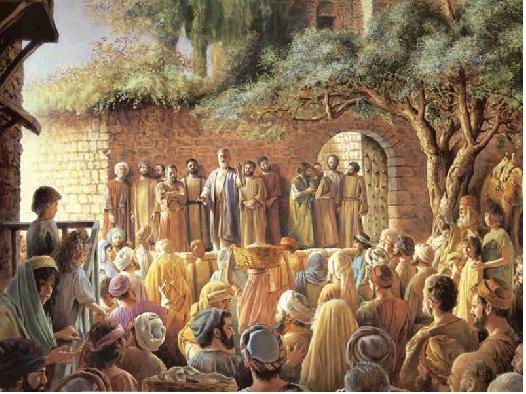
Acts 2:12-39

Josephus, the Jewish historian, informs us that the normal population of Jerusalem was roughly 150,000.  However, at this particular time in Acts 2 with the celebratory Feasts of Weeks and the Passover day to follow, there were roughly 1 million people in Jerusalem.  It is at this time that the Church begins its work in the world.  As the noise of something miraculous begins to filter into the streets and countryside, people gather into the temple to witness the events for themselves.  The text of Acts 2:12 says that some people were perplexed, while other were amazed, and some had already passed judgment on the event.  Realizing that this miracle of speaking in tongues had caused such commotion, Peter like Jesus, stands up and addresses the captive crowd.  If we read the Gospel accounts, we find that Jesus did not waste a miraculous event  – it always had a purpose of explaining the Gospel message to the person or the crowd.

Essentially, Acts 2 provides us with Peter’s first sermon.  His theme: Jesus is the Messiah; a theme that would be part of most other sermons and speeches in the book of Acts.  Peter refutes the charges that the Apostles were drunk and then he continues to demonstrate the purpose of this miraculous event.  Peter shows that Jesus is the Messiah with five proofs.

The first proof is Jesus miracles during his earthly ministry (v.22).  God authenticated Jesus through miracles and signs.  He turned water into wine, calmed the winds and waves, cast out demons, healed the sick and lame, raised the dead, and more.  The second proof is an Old Testament prediction of the resurrection (vs. 23-31).  Peter informs us that the perfect life of the Christ would allow for such a resurrection to take place.  Then, Peter further explains that the reference to the “Holy One” in the Psalms passages is not a reference to David but to the Messiah thereby predicting the resurrection of the Messiah.  A third proof is found in vs. 32 where the Apostles say that they were eyewitnesses to His resurrection.   A fourth proof is Peter’s appeal (v.33) to the supernatural events of Pentecost that were sent by Christ.  In this verse, Peter says that that “He (Christ) poured out what you now see and hear.”  The fifth and last proof that Peter gives for his claim of Jesus as the Messiah is the ascension of Christ.  Peter says that David did not ascend to heaven, rather Jesus did (cf. Acts 1:9-11).  Peter closes out this five-point sermon with the simple conclusion that Jesus is the Christ (or Messiah), the very one that you (the crowd) has crucified.

Because of Peter’s persuasive, Spirit-empowered message, many people were convicted and needed to be instructed on what they needed to do to make things right.  Peter tells them to repent of their actions, meaning a change of mind concerning who the Messiah was.  Up to this point in time, the Jewish mind thought Jesus was some kind of false Messiah and the True One had not come yet.  However, Peter convinces them otherwise, and so they change their thinking (now having all the right information) putting their faith and trust in the real Messiah.  Next, they are ready to publicly show others this new life they have received through water baptism.  Now, the Holy Spirit that came on Pentecost, dwells in the hearts of each believer when they believe in the real Messiah – Jesus Christ.  But wait!  Don’t miss verse 39 that says that this promise of salvation is offered to all people.  And so the witness of the Church begins at Pentecost and is still penetrating the hearts of people today.  

Wednesday, October 5, 2011

To Speak Or Not to Speak...Is That Really the Question?


Acts 2:1-13

The day of Pentecost was an annual feast at which the Jews presented their first-fruits unto God.  “Pentecost” is a Greek word, when transliterated into English, means fiftieth.  This feast took place on the 50th day after Passover.  All Jewish males had to be present at the central sanctuary (Exodus 34).  This accounts for such a large number of Jews that were present.  In contemporary terms we might say that everyone who was important according to the Jewish faith was present at this feast.  The scene was set for God to do something big; and to say that He does something awesome is truly an understatement.

It must have been an amazing sight to see these flaming tongues descending from above.  We must remember that Luke is attempting to describe something that has never happened before nor has it happened since.  He uses similes and metaphors to describe what he sees.  How do you describe something you’ve never seen before?  Ordinarily, you would compare the unknown thing to something that you know.  Honestly, we are not completely sure what these tongues looked like; but is that the point?  God could have use anything to picture the Holy Spirit, but I often wonder why he used tongues.  My first thought that comes to mind when I hear the word “tongues” is mouth or mouthpiece.  The Holy Spirit is to be our mouth or mouthpiece, He speaks through us to others; and this is what happened at Pentecost.  But was the miracle the act of speaking in tongues, or was the miracle the number souls that were saved as a result of this unique event?  We tend to major on the speaking in tongues which the Apostles did, and minor on the souls that were saved which the Holy Spirit did.

Because of this unique phenomena, the crowd, composed of many different people groups, is confused and amazed at the same time.  How can Galileans, who were considered unlearned men, able to speak in so many languages?  But were the tongues given so that all people groups present could hear the Gospel?  These different people groups, in Jerusalem on this festive occasion, would have known the trade language of the day.  So the question remains why would the Apostles need to speak in tongues if most people in Jerusalem were already able to communicate with one another through a common language?  It seems that tongues were more than just a speaking miracle; they were mean to authenticate the message of the Apostles.  And just like the miracles that Jesus preformed; there was a reason for Jesus’ practices.  Jesus preformed miracles to get the attention of the crowd so that he could preach the Gospel to them. 

Peter, like Jesus, does not waste an opportunity.  Peter uses this miraculous event to preaching a Pentecost sermon which was also his first sermon.  The Holy Spirit saved 3,000 souls on this occasion; but we often forget that this same Holy Spirit indwells each believer to guide them throughout their life.  The hard thing is letting him lead us, especially when we think that we have a better plan... 

Sunday, September 25, 2011

Looking and Listening for His Return!


Acts 1:15-26

Peter stands up in the midst of the Apostles, taking a leadership position, and realizes the need to find a replacement for Judas?  Why does he recognize such an imminent need?  Did they have to chose another replacement?  Why couldn’t they stay with the original Eleven?  Peter had remember what Christ had said in Matthew 19:28.  Christ tells the Apostles that when the kingdom comes they will sit with him on Twelve thrones and rule over this kingdom.  Consequently, Peter does not know when Christ will return; he doesn’t have the benefit of hindsight like we do.  For all Peter imagined, he thought that Jesus would be returning next week!  Peter was actively look for the return of the Savior...so why don’t we? 

Peter goes on to quote from two Psalms (Psa. 69 and 109), the first explaining what had happened (Judas’ defection and death) and the second what they should do about it (replace him).  Two men were chosen, and after casting lots, God directed the Apostles to chose Matthias.  Some have often asked, why did they cast lots?  Isn’t that an Old Testament practice?  Casting lots was done on this occasion because they Apostles had not received the Holy Spirit yet.  The Holy Spirit would descend on them and indwell them in the next chapter of Acts.  We don’t have a need to cast lots today when making decisions because we have the Holy Spirit who indwells us.  He helps us to make decisions that are both wise and follow with God’s will; but we must listen to His still small voice.  The Holy Spirit is speaking to us, and he often does this in various ways and mediums, but can we hear him?

The Apostles prayed to the Lord and asked him to show them who He had already chosen.  The Lord directed them to Matthias as the qualified replacement.  Now the group is whole once again and ready to be His witness to the entire world.  If we think back to Jesus’ original selection of the Twelve, we see that He did the same thing.  He spent all night in prayer before He went out to select these twelve ordinary men that would turn the world upside down.  The amazing and mind-boggling fact is that even through Jesus know all things and what would happen with these twelve, He still chose Judas! 

Sunday, September 18, 2011

God's Master Plan


Acts 1:12-14

This passage in Acts is a portion of the larger narrative in Acts 1:12-26 where the Scriptures inform us that the Apostles chose someone to replace Judas.  And I plan to discuss that in later posts, but the first few verses of this narrative caught my attention in a rather providential way.  I had been thinking of what I wanted to blog about in this passage and nothing really struck me, until, that is, I listened to the Sunday evening message at LMBC.  We had a guest speaker named Joyce Olver, who gave her testimony of how God had providentially protected her on the events of September 11, 2001.  She was a stewardess who was scheduled to be on Flight 11, the very one that crashed into the Twin Towers.  Her riveting testimony explained how God had a plan for her life and how He went to great lengths to show her this.  If she had not listened to God’s plan and went with her original plan, she would have died. 

As I thought about her testimony, I couldn’t help but reflect back to the book of Acts, particularly to the day after Jesus ascended up into the heaven.  The day of the ascension must have been an awesome and glorious day for the disciple to watch, a day that they would never forget!  But what about the day after?  The text says that went a Sabbath’s day journey (roughly a ½ a mile) back to Jerusalem per the instructions of Christ.  They were told by Christ to wait for the Holy Spirit to come and then they were to go out and be his witnesses to all the world (Acts 1:8).  But what if they chose to go out and be his witnesses before the Holy Spirit came upon them?  In other words, what if they chose to fulfill their commission without the power of the Holy Spirit?  Do you think it would have been successful?  I rather doubt it would have been; it probably would have been an utter failure.  Yet, why does this seem to be a growing phenomenon within the life of a Christian?

You see the simple fact of the matter is that it’s easier to do things our own way, and then enlist the power of God when we need it most.  Our western mindset of individualism often influences our thinking more than we would like to admit.  We think that our methods are better, and we will let God take a break from helping us on this matter.  God is the first place we need to go; He is not a last resort!    We all know that this is not a new concept; the roots of this deception goes back to the Garden of Eden when Satan tempted Adam and Eve by saying, “there is a better way...”  Man has always wanted to control his own destiny, and if we were to survey history we would soon realize that it has caused immense and irreversible problems when man takes that destiny into his own hands.  God’s plan is far greater and better; his providence is leading us in the right direction, but are we listening to him?  It’s the simple truth of being “in Christ” that really puts us in our place.  When we become a believer, we are literally placed into the family of Christ.  Our identity is now wrapped up in who He is, not who we want to become.  Our last name is changed, we get new brothers and sisters, we now have a father who meets every need; and best of all, we will be moving someday!

God’s plan for our life needs to be our plan; rather that trying to change God’s plans into our plans.  Sometimes I wish that God would pull back the curtain and give me glimpse of my life and all I would do for him, but in the same breathe I think I would be terrified because I would not want to see how He gets me there.  God’s ways are far above our ways, but thank God He has a master plan He wants to work out in the life of every believer.  Your life is valuable to God and He has a plan for it!  

Sunday, September 11, 2011

9/11: How Do We Respond?

Acts 1:9-11


Acts 1:9-11 is the major passage in the New Testament that describes the ascension of Christ into heaven after His resurrection.  The disciples are staring at Christ as He ascends into heaven, wondering when he will return.  Just then two angels who are sitting near the disciple speak up and ask the disciples why they are continuing to stare at Christ ascending into heaven.  It seems the angels knew that the disciples where thinking about when Christ would return.  The angels encourage the disciples by telling them that Christ will come back in the same way that he left.  Those words from the angels are very significant for it proves that Christ will come back one day in a visible and physical form.  However, the point of the text is that the disciples where loosing focus and the angels had to pull them back to the earth.  Christ had just given them instructions; He had commissioned His disciples to be His witnesses. 

Now, reflecting on the events of 9/11, events that forever changed America.  From the news footage and statistics, there were more than 400 first responders that died responding to the crisis at the World Trade Center.  What was truly amazing was that people were running into the building, into the very place that was hazardous, dangerous, and deadly.  Many lost their lives for running back into the building because the thought of saving one person was worth the effort.  And we all know and heard today the countless stories of heroic efforts of so many ordinary people that sacrificed in a variety of ways.  But what if these people, and these first responders, decided not to respond.  What if they chose not to help, not to sacrifice, not to pitch in wherever needed?

I am so grateful that these first responders decided to go and sacrifice, just like I am so grateful that the disciple chose to respond to the command of Christ and go and sacrifice.  What if the disciples, watching Christ ascending into heaven, decided not to go and just sat, waiting for Christ to return?  The first eight chapters of the book of Acts show example after example of people who sacrificed for the cause of Christ, who did whatever it took to get the Gospel out to as many people as they could.  Countless people were reached with the Gospel, and are still being reached with the gospel today, all because twelve disciples decided to sacrifice and go!

So what’s our excuse?  We’ve been given the same commission as the disciples were given.  What if we decide not to respond to that still small voice?  I wonder what God has in store for those who do respond, and I wonder what we miss when we don’t respond?   Why is it that we have to pull teeth to get people to serve in ministries, but they are willing to sacrifice anything for sports and other hobbies?  People ran into the world trade center without thinking for a moment about their well-being to help people they did not even know.  Yet people cross our paths every day and what kind of thought come to our mind??

We will never forget the events that happened on 9/11 and I hope we will also never forget the commission that Christ gave to all believers: go and make disciples!

Thursday, September 8, 2011

The Power of the Holy Spirit


Acts 1:8

Acts 1:8 is a very important verse for the study of the book of Acts because it not only gives us a theme but it also gives us an inspired outline to the book.  You see Jesus prophesied to his disciples that they would be witnesses for him starting out in Jerusalem, then moving into Judea and Samaria, and finally to the uttermost parts of the earth; and this is exactly what happens.  The Gospel slowly progresses outward from Jerusalem and travels some 1,800 miles to Rome.  The mission of the Gospel is not a static one, nor is it stagnate, but it is moving and it is powerful.  However, the Gospel’s progress is only as powerful as the people who are surrendered to taking it to the ends of the earth.

 “But” you will receive power is how Acts 1:8 starts out.  The “but” is contrasting the thought of verse 7.  You see in verse 7 the disciples were concerned with the coming kingdom that Christ had promised, and Jesus tells them that they don’t need to worry about that at this time.  They rather need to focus on being his witnesses on earth.  “Witnesses” becomes an important term in Acts, used some 19 times in the book of Acts alone.  When our Western minds kick into gear some of us have fond memories of witnessing to others about Christ; or we might say that were going out soul-winning. Then others might say that our memories of soul-winning were much more discouraging and frustrating.  We’re going out to wins some souls for Christ – a command from the very pages of Scripture.  But, does the term “soul-winning” really catch the essence of what the early church was supposed to be?  You might say it’s a matter of semantics, but I think there is more to it than that.   

“Witnessing” means to testify of the person and work of Christ; it’s where we get our term testimony.  But according to the words of Scripture the disciples were to do the witnessing and then the Holy Spirit was to do the saving.  Soul-winning sounds like we (the believers) are the ones who do the saving.  Some like to major so much on the methodology of soul-winning that they forget to give the Holy Spirit room to do his convincing work.  Believe you me, I think some methods are better than others and I am not condemning any one type of method.  What I am saying is that some magnify their methodology over the very message that they preach.  Sound familiar?  Do the Pharisees and religious leaders ring a bell?  They were guilt of magnifying the oral law (their traditions, codes, and laws) over the very written words of Scripture.  Their traditions and laws could not save, but God’s Word can! 

We are not the ones who do the saving, the Holy Spirit does.  The early church, and the church of today, is given a task of witnessing or testifying to others of what Christ has done; leave the saving part to the Holy Spirit.  Because, really, if it were up to us, we could not save a single soul from the punishment and fires of hell; but the Holy Spirit can and He still does!   

Saturday, September 3, 2011

Getting the Big Picture by Narrowing Your Focus


Acts 1:5-8

One would expect the above question to have an obvious answer, but does it?  Sure there were times when the Apostles did not fully understand why Christ came; there are many examples.  Mark 1:35-37 speaks of one such occasion.  After healing many people Jesus went off to a solitary place, but the people would not leave Him alone.  Simon goes to look for him and tells him that the people are looking for him.  Jesus speaks up to Simon and says the reason why I have come is to preach the good news.  Sometimes even the closest people to Jesus did not really understand His purpose for coming.

In Acts 1:6-7 the disciples ask Jesus when he will be coming again to restore His kingdom.  Did they miss the big picture again?  The word “restore” is Acts 1:6 carries the concept of a political restoration.  So the disciples were asking Christ if He was coming again to restore his political kingdom, when Jesus did not come to set up a political kingdom but a spiritual one.  However, the Jews rejected Christ and it seems that they would have rather had a political kingdom than a spiritual one.  What is interesting though is that when the disciples asked Jesus if He was going to restore his kingdom, He did not deny it; rather He told them that it wasn’t for them to know the future.  The point is that they were concerned more with the future rather than the present.   

This concept is carried over into the realm of prophecy and study on end times events.  People want to know when these prophetic events will happen; some even become obsessed with it.  Why?  Personally, I think that people want to know when prophetic events will happen so that they can wait until the last minute to get their affairs in order.  But Christ spoke of end times events from a different perspective.  He tells his disciples in Acts 1:8 that they need not worry about the future kingdom, they need to focus on the present expansion of Gospel to the kingdoms of this world. Truly one can be too heavenly minded that they are of no earthly good. 

In a sin-cursed world where the prevailing focus is on self, it’s easy to focus on the future and the glorious restoration of all things.  However, Christ has called us to be salt, to influence and effect his world.  He has given us that same command He gave the disciples – be my witnesses.  Be my light in the dark world, show them that there is hope, and that hope is only found in Him!

Monday, August 29, 2011

Apologetics, First Century Style


Acts 1:3

Throughout the book of Acts, the central message that seems to be taught by the Apostles and the disciples is the resurrection of Jesus Christ.  Every other religious founder on earth has died, but the founder of Christianity came out of the tomb and is alive today!  Luke says that after Jesus was crucified, He gave many convincing proofs that He was alive.  What is interesting is that the Greek word translated as “proofs” is used only in this passage.  Nowhere else is this Greek word used in all of the New Testament.  The word has the idea of a proof that directs a person to a conclusion; just like a normal apologetic.  What this means is that Jesus’s appearances were convincing, even to those who had not expected a resurrection.         

Luke lists at least three specific proofs, and these are probably categories of proofs that can be developed further.  First, Luke says that Christ appeared to the Apostles over a period of forty days.  He did not appear just once, twice, or three times.  Christ’s followers saw him multiple times so that is was clear that they were not dreaming or hallucinating.  Second, Luke says that Christ spoke and taught about the kingdom of God.  The disciples clearly remembered that He taught about the kingdom of God because just a few verses later they are talking about it; this was the same Jesus.  Third, Jesus ate with them, and what a meal that must have been!  They saw Jesus put food in his mouth, chew it up, swallow it, and eat some more.  What more proof does a person need that Jesus is alive?

The disciples saw Christ, they heard Christ, and they shared a meal with Him.  There can be no refuting something that is this certain!  Over the centuries, skeptics have tried to disprove the resurrection.  Ironically, many of those skeptics have followed the evidence and have become believers in Jesus Christ.  When you follow the evidence for the resurrection of Christ there is only be one infallible truth – Jesus is alive!  The early church proclaimed the resurrection from the mountaintops, in the middle of the city, on the hills of the deserts, to the religious leaders, in the synagogues, and to anyone who would listen.   So, what then is our problem for not proclaiming this infallible truth? 
 

Friday, August 26, 2011

On the Heels of the Resurrection


Acts 1:1-2

I have read many of the resurrection passage that are given in Scripture and have always dreamed of what it must have been like to see a resurrected Christ!  That dream will be a reality one day!  But, honestly, my dream ends there and I can now sit back and rest – Selah.  As I began to ponder this thought I had a strange feeling that I was forgetting something.  Shouldn’t seeing the resurrected Christ be enough for anyone?  As I read this text in Acts 1, I realized that something was missing.  Jesus didn’t stop his work after the resurrection; He continued to pour his life into his followers.  In Luke 24:45-49, Christ appears to his disciples after the resurrection and “connects all the dots” for them.  You see they thought, like I did, that after the resurrection everything is over.  Verse 45 says that Christ opened the minds of the disciples so that they could understand the Scriptures?  But I thought they already knew the Scriptures?  Yes, but there were more Scriptures to be written!  Thus, verses 46-49 summarize what will take place as we read through the book of Acts: the disciples preach the resurrected Christ, salvation for all nations is offered beginning in Jerusalem, the disciples will be His witnesses to all people, and Christ will send the Holy Spirit to give them the power to accomplish these things.
Then it hit me in a phrase like this: we must not stop with the resurrection; we must continue on to fulfill the Great Commission.

So what does all this mean for readers of the 21st century?  It means we must follow through.  Christians cannot be content with only the resurrection, and the hope it gives us for the future.  We have a job to do now.  We must carry out the Great Commission just like the followers of Christ did in the book of Acts.  Forgetting to follow through can cause us to become selfish.  By this I mean that if we don’t share the gift of salvation with others we are being selfish.  When refuse to move pass the resurrection toward the Great Commission we become selfish.  Now, this entry is not to discuss the many facets of the Great Commission, of which I believe there are as many as there are kinds of people.  But here’s the bottom line as I try to pull all this together.  The disciples imbibed all they could from the ministry of Jesus for 3½ years, but there came a time when they had to put what they absorbed and learned into practice.  They could not continue to sit at the feet of Jesus like Mary did, it was time for them to get up and serve like Martha did.  Continuing to sit at the feet of Jesus and not pass on what they learned to others would be selfish. 

If we are going to follow through then let’s make sure we have soaked with Jesus first, then we can unselfishly serve Christ by obeying his command to make disciples.
 

Thursday, August 25, 2011

The Gospel Train


...a synopsis of Acts

I can remember in my childhood years singing the song, “The Gospel Train.”  Little did I know that while it was a hymn sung by many protestant denominations in the 1900s, it’s origins run deep into the Unground Railroad.  It was actually a song sung by slaves that were planning to escape and head north for freedom.  Slave owners had no idea that a group of slaves were planning to escape because singing was a common part of any slaves’ day.  But when I think about the phrase the Gospel Train, I think of the book of Acts.  You see the book of Acts is the inspired story of the one and only Gospel train that shoved off from the station in Jerusalem and didn’t stop until it rolled into its destination in Rome.  There were many people who got on the train, but there were also many unsuccessful attempts to stop this train.  When Luke wrote the book of Acts he wanted to show his readers that nothing could stop the Gospel from traveling to its intended destination.  It began with Jesus in Jerusalem (Acts 1) and would travel all the way to the Gentiles in Rome (Acts 28).  

Upon reading the last few verses of Acts 28, a feeling of closure is far from the words of Luke.  Acts ends quite abruptly (much like the book of Jonah) and leaves many questions unanswered.  Or does it?  For Luke, his chronicle of the Gospel’s work through a variety of men and women was finished, but for us, who read the book of Acts in the 21st century, we realize that the work of the Gospel is not finished! In many ways the Gospel train is still rolling from destination to destination.  The question we must ask ourselves is what are we doing to direct people towards that train?  Are we hindering people from getting on that train, or worse, are we trying to stop that train?  Sometimes I think we live like the train never existed, at least that is what our actions show.  But we cannot get away from that whistle; a constant nagging that there is room for more people to come aboard.  Some just need an invitation from a friend, while others might take a little work on our part...aren’t they worth it? 

Ray Stedman, an author and pastor, entitled his written sermons on the book of Acts as, “God Unfinished Book.”  It’s a great description of the book because it shows that there is still more to be written.  The stories of Peter and John, Stephen and Barnabas, Paul and Silas, may be ended in a historical sense, but they have passed the baton on to the Christians in the 21st century.  Our methods may be different, and our culture a little dismal at times, but our message will always be the same.  Like it or not, we are part of God’s Unfinished Book.  May our stories reflect the same earnestness, faithfulness, and compassion as those before us.