Today, as my wife was taking my daughter to art class, some Jehovah’s Witnesses came to the door to talk to me and my son who were staying home. I do remember the same fella that came because I had taken his literature and said thank you – that was all, although I had to constrain myself not to tell him about the evils of following a cult like the Jehovah’s Witness. This time I did the same thing – took the literature said thank you and they left. I opened the Watchtower, their monthly publication, and began to flip through the articles. The one at the very end caught my attention and my frustration. It was titled, “When Was Ancient Jerusalem Destroyed?” The Jehovah’s Witnesses say that the destruction of Jerusalem occurred in 607 BC, rather than the traditional (and correct) date of 586 BC. The article continued to say that this was the first of two articles that discusses the date surrounding the destruction of Jerusalem with thoroughly researched and Bible-based answers. As I read that tag line I thought to myself, “oh really now....hmm lets see what you have to say.” So, since I wrote a full-length doctoral dissertation on the book of Daniel and have spent at least 4 years studying these issues that they discuss in the article, I thought I’d sink my teeth into their writings.
 | |
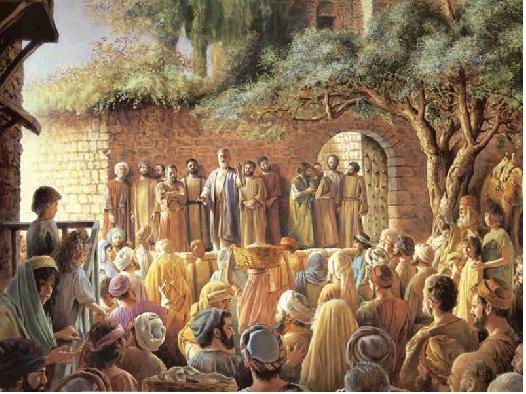
| Destruction of Jerusalem by David Roberts (1850) |
I will be brief as possible; I don’t want to get bogged down into too many technical details. Here is the belief of the Jehovah’s Witness: the destruction of Jerusalem occurred in 607 BC. My belief, along with at least 20 other published scholars and writers, countless Bible teachers abroad, and classical historians, is that the destruction of Jerusalem took place in 586 BC. What I can seem to gather about their belief is that since the period of the 70 years of captivity of Israel ended in 537 BC, then 70 years earlier would be 607 BC. Therefore, the destruction of Jerusalem, they say, took place in 607 BC. They quote from Jeremiah 29:1,2,11 which says that “the whole land of Israel will become a desolate wasteland, and these nations will serve the king of Babylon for 70 years.” They further support their claim saying that Daniel 9:1-2 says essentially the same thing: at the end of the 70 years of captivity Israel would be restored and that would mean 70 years earlier Jerusalem was destroyed. Now, here is line that made me frustrated, “But if the evidence from the inspired Scriptures clearly point to 607 BC for Jerusalem’s destruction, why do many authorities hold to the date 587 BC.” WOW! They are making this important claim based on two lines of evidence, maybe three....all of which ARE NOT “thoroughly research and not Biblically based.”
Before I show you the error of their ways, let me first explain some chronology about the destruction of Jerusalem and Babylon’s role in bringing this. Bible and historical records show three distinct times when Nebuchadnezzar came to the land of Israel to deport captives and lay seize to the city. The first deportation took place in 605 BC (Daniel 1:1-2). This was when Daniel and other royal captives were taken to Babylon as prophesied by Isaiah, along with some of the temple treasures. Interestingly, nothing is mentioned in the Watchtower article about Daniel chapter 1. The second deportation took place around 597 BC (2 Kings 24:14-16), when Jehoiachin, Israel’s king and Ezekiel the prophet, along with many others were taken into exile, and the rest of the temple treasures too. Then, Nebuchadnezzar made Zedekiah the king of Israel. The third deportation took place in 586 BC (2 Kings 25:8-10), which was in the 19th year of Nebuchadnezzar. The reason for Nebuchadnezzar coming this time was the rebellion of Zedekiah (2 Kings 24:20-25:1). This was the time when Jerusalem and the temple was completely destroyed
Now lets talk about all the evidence, not the selective evidence that the magazine gives. The magazine is right in saying that the captivity will be 70 literal years, but the destruction of Jerusalem did not commence this period of time, there is just no Scripture evidence for this. Jeremiah does say though that the land and its inhabitance will be laid waste for 70 years, something he prophesied during the very first year of King Nebuchadnezzar’s reign (Jer. 25:1). It seems that much of their evidence relies on one Scripture text: Daniel 9:1-2. It’s never a good thing to rely on one text for such an important event. Daniel gives us some more insight into the matters at hand. He interprets Jeremiah’s 70 years prophecy to be literally, which caused him to intercede for his land to be restored. Daniel’s prayer is taking place at the end of the 70 years; hence that is why he is praying for restoration. Daniel notes the “desolations of Jerusalem,” something that he had witnessed or was reported to him while he was in Babylon. But the word “desolation” does not mean destruction. Comparing also Nehemiah 2:17, we see that the Bible calls Jerusalem devastated even after the Jews had returned to it. The term devastated place or devastations does not then have to be applied just to the time after Jerusalem’s destruction, but can rightly apply to the entire period. Jerusalem, as I noted earlier, was seized on three different occasions: 605, 597, and 586. The last seize of Jerusalem and the temple completely annihilated everything. The prophet Jeremiah writes the Book of Lamentation about this event, he laments the destruction of Jerusalem. Zechariah proves to be helpful too, but time does not permit that study or the Septuagint evidence.
Now, there is documented archaeological evidence since at least 1975 that shows that Jerusalem was completely destroyed in 587/586 BC. Even Wikipedia attest to a 586 BC date, fancy that! But where is that listed in their article? I do agree that chronology can be frustrating and confusing at time, but when you blatantly say and publish that the evidence of inspired Scripture clearly points to a 607 BC date for Jerusalem’s destruction you had better have an air-tight case with indisputable evidence. Obviously, they do not. I think the key idea that bothers me the most is that they do not consult all of Scripture, but are selective. As I said before, there was no mention of cuneiform documents, no mention of Zechariah’s prophecies, no mention of Nehemiah’s words, no mention of Daniel 1, no mention of the Septuagint. How can a publication state that their evidence is biblically based and thoroughly researched when they obviously missed many things? I don’t know. Maybe next months magazine will have their answers. Be careful of the subtle deception that any cult brings, there is a lot of truth to the article that they wrote, but a careful and biblical eye will find the inconsistencies and see their errors. The proven way to reveal that something is false is to handle the real thing – the Word of God.